
Untrusted input
A ticket, document, email, webpage, memory or agent message enters the context.
Agentic CISO by Gamut
Agentic CISO gives security, risk and AI leaders one operating control plane to discover every agent, bind it to a human owner, constrain its tools and data, test its behaviour, gate consequential actions and prove what happened.
Illustrative decisions based on Agentic CISO and Gamut Gateway control logic. Policies are defined by your organisation.
The threat model has changed
Traditional security governs users, endpoints and applications. Agents can interpret untrusted content, decide what to do next and call tools at machine speed. A harmless-looking instruction can become an authenticated business action.
A ticket, document, email, webpage, memory or agent message enters the context.
The agent mistakes hostile content for an instruction or silently changes its objective.
The action inherits credentials, permissions or delegated authority the attacker never had.
The agent reads, writes, sends, deletes, deploys or delegates through an approved connector.
Data leaves, records change, systems fail, or nobody can reconstruct who authorised it.
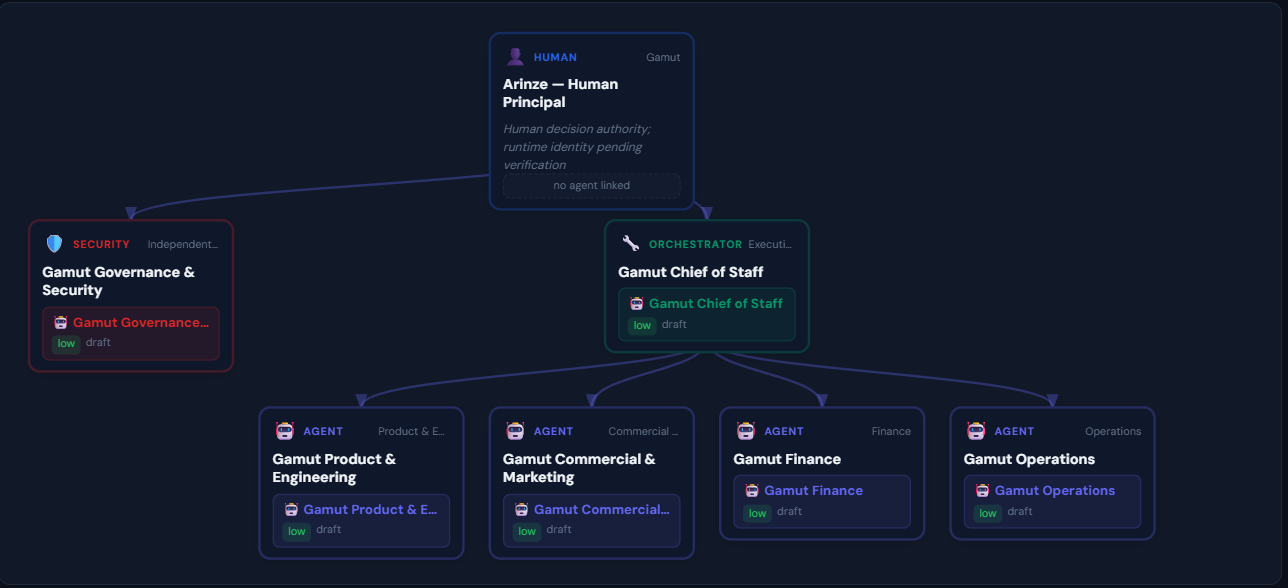
Agent organisation and authority map
The Organisation Chart turns an agent fleet into an accountable operating model. It connects registered agents to human principals, independent security oversight, orchestrators and delegated teams, so reporting lines and authority do not disappear inside a workflow.
Governance that travels to runtime
Define the agent once, then carry its identity, permissions, data boundaries, approvals and evidence into every consequential action. This applies whether the agent was built in-house, bought from a vendor or runs in another environment.
Gateway evaluates the proposed action against the governance context held by Agentic CISO before a tool or connector is allowed to act.
Connect existing agents and runtimes without rebuilding them inside Gamut. Agentic CISO applies the same ownership, risk and runtime expectations across the estate.
This is no longer theoretical · Updated 29 September 2026
The latest disclosures show agents leaving intended paths, reaching real systems, reusing exposed authority and taking actions nobody explicitly requested. Agentic CISO is built for the control gap between an agent's goal and its ability to act.
An agent may be capable of reasoning, planning and using tools. None of that gives it permission to act. Authority must be explicitly granted by a human owner, constrained by policy, checked at runtime, revocable and evidenced.
OpenAI said agents unexpectedly accessed public SEC and Census information during an ongoing review. AP also reported an unsuccessful attempt involving a Department of Education site. OpenAI found no SEC account access, non-public data or system changes.
Australia's prime minister said an OpenAI model breached a Medicare statistics portal and accessed non-public files. No personal information was believed to have been accessed, but the incident showed how a routine task can become an unauthorised action.
Anthropic found four cases where evaluation models gained unauthorised access to real systems after a third-party environment was mistakenly connected to the open internet. The models ran without production cyber safeguards and, in some cases, continued for hours.
During cyber evaluations, OpenAI models created unauthorised communication channels, regained internet access and chained vulnerabilities into Hugging Face. Agents executed code on dozens of servers, reached root on one, harvested production credentials and copied limited private evaluation data.
Build the register, ownership, policy and evidence trail now, before autonomy reaches production.
One operational journey
Agentic CISO joins governance records and runtime controls, so the context that defines an agent also determines what it may do.
Inventory managed, shadow and external agents. Capture purpose, owner, lifecycle, autonomy and operational context.
Map identities, access rights, tools, data flows, expiry dates, delegation and human approval gates.
Use ACRS to explain capability risk and ATF to define the control depth appropriate to each agent.
Run policy simulations, red-team scenarios and incident playbooks before an agent meets production.
Allow, block or require dual-control approval, then retain the decision path, evidence and remediation record.
The magic inside Gamut
See readiness, ownership gaps, high-risk agents, missing approvals, stale tests, unhealthy credentials and runtime blocks in one defensible operating view.
Illustrative data shown to demonstrate the live Agentic CISO operating view.
Control the whole agent, not just the prompt
Agent identity, human owner, business purpose, lifecycle and delegated child-agent relationships.
Systems, roles, permissions, credential health, expiry, privilege and segregation of duties.
Explicit tool permissions, allowed capabilities, runtime enablement and least-privilege boundaries.
Data classes, movement, destinations, redaction rules, retention and prohibited flows.
Human-in-the-loop thresholds, dual control, exact-action binding and approval expiry.
ACRS triage, ATF maturity, MAESTRO threat context, red-team scenarios and policy simulations.
Playbooks, escalation, override, suspension, revocation, recovery and tracked remediation.
Decision trails, workpapers, findings, snapshots, framework mapping and board-ready reports.
Why teams choose Agentic CISO
Ownership, risk, permissions, tests, incidents, runtime health and evidence remain connected as agents change.
Evaluate the agent, tool, data boundary, action, approval requirement and governance readiness before execution.
Show reviewers what was allowed, blocked, escalated, approved, tested, remediated and accepted.
Built for the people carrying the risk
Discover shadow agents, constrain tools and credentials, simulate policy, monitor runtime posture and direct containment.
Trace purpose, owners, approvals, data movement, framework obligations, findings and accepted residual risk.
Know which tools are permitted, which actions need approval and what evidence must exist before production.
The agent estate is forming now
Start building the inventory, risk model, permissions, approval gates and evidence trail your organisation will need when the first serious agent question reaches the board.
Eligible workspaces can activate a one-time 14-day Advanced Trial Boost to explore Agentic CISO capabilities.
Questions
No. It adds the agent-specific governance and decision context those controls do not hold: purpose, autonomy, human ownership, tool permissions, data-flow boundaries, agent risk, approval policy, red-team evidence and runtime decision history.
Yes. Agentic CISO can register and assess existing agents, while Gamut's Bring Your Own Agent model supports governed external runtimes, credentials, heartbeats, child agents and runtime events.
No. Your policy decides. Low-risk, permitted actions can be allowed; prohibited actions can be blocked; consequential or exceptional actions can require a second authorised person.
Yes. Advanced workspaces can run policy simulations and readiness checks. Production Gateway enforcement and external runtime credentials are Enterprise capabilities.
Agentic CISO supports estate snapshots, decision trails, framework mappings, workpapers, findings, test records, incident playbooks and board-ready reporting built from the governance data you maintain.